
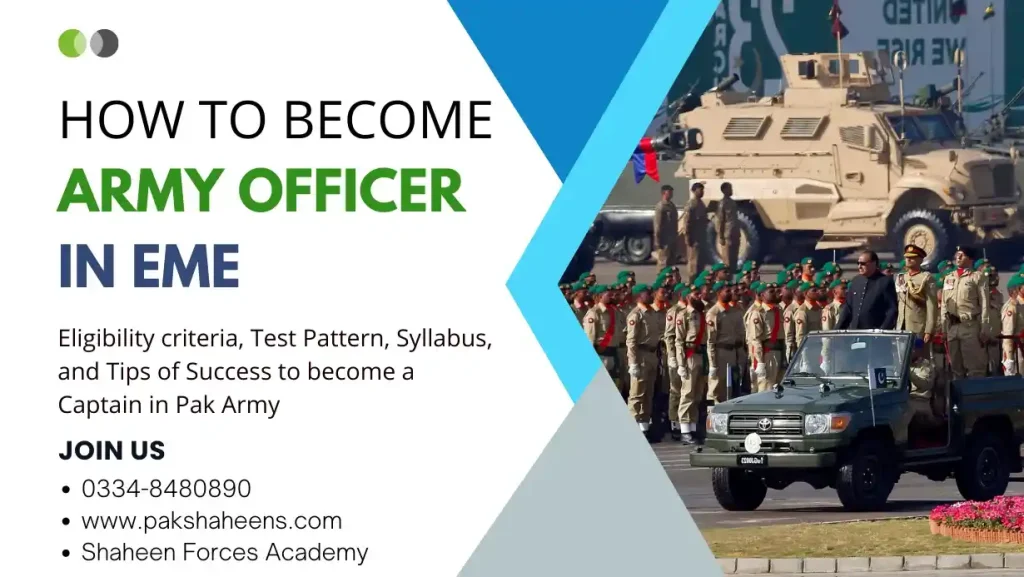
How to become an Army EME Officer?
In the vast world of military operations, the role of Army EME (Electrical and Mechanical Engineers) officers is crucial. These highly skilled professionals are responsible for managing and maintaining the complex machinery and technology that powers the army’s operations. From armored vehicles to advanced weapon systems, Army EME Officers ensure that the equipment is in top-notch condition and ready for any mission.
In this article, we will explore the Eligibility Criteria, Selection Process, Test Pattern, Test Syllabus, Experience, Expertise, Authority, and Trust associated with Army EME officers, highlighting their significant contributions to the military.
Online Registration of EME in Pak Army
Start Online Registration Date of EME
End Online Registration Date of EME
23 Dec, 2025
16 Jan, 2026
Eligibility Criteria to Become Army EME Officer
To be eligible for the Direct Short Service Commission as an Army EME Officer, candidates must meet the following basic requirements:
Nationality: The candidate must be a citizen of Pakistan. Foreign nationals are not eligible for this program.
Gender: Both male and female candidates can apply.
Age Limit: The age limit varies depending on the educational qualifications of the candidate.
Generally, the age limit is between 28 to 35 years. (Normal age limit is 28 but for few serving personnel age limit is 35 years)
Marital Status: Both married and unmarried candidates can apply.
Educational Qualifications for Army EME Officers
Candidates must possess the following educational qualifications to be eligible for the Direct Short Service Commission as an Army EME officer:
Engineering Degree: The candidate must have a Bachelor’s degree in Electrical Engineering, Mechanical Engineering, Mechatronics Engineering, Avionics, Aerospace, and Electrical & Mechanical Engineers or any other relevant field from a recognized university.
CGPA/Percentage: The candidate must have a minimum CGPA of 2.5 out of 4 or 60% marks in the annual system.
Accreditation: The engineering degree must be accredited by the Pakistan Engineering Council (PEC).
Physical Standards of EME Officers in Pak Army
Candidates must meet the prescribed physical standards set by the Pakistan Army. These standards ensure that candidates possess the necessary physical fitness to perform their duties effectively. The physical standards include:
Height: The minimum height requirement for male candidates is 5 feet 4 inches (162.5 cm), while for female candidates, it is 5 feet (152.4 cm). (Check your Weight HERE)
Weight: The weight should be proportionate to the height as per the Body Mass Index (BMI) standards.
Vision: The candidate must have a minimum distant vision of 6/9 in one eye and 6/12 in the other eye with or without glasses. Color vision should be normal.
Selection Process for Army EME Officers
The selection process for Army EME officers through Direct Short Service Commission consists of the following stages:
Initial Registration: Candidates are required to register online through the official Pakistan Army website during the announced recruitment period. After due date registration can not be done. In case of any mistake while doing online registration, contact Selection Center. Preliminary Tests: Candidates undergo preliminary tests, including a written intelligence test, a verbal intelligence test, and a basic medical examination. Physical Tests: Candidates who qualify the preliminary tests undergo physical tests, including a physical endurance test and a medical examination conducted by the Army Selection and Recruitment Center (AS&RC). ISSB Tests: Shortlisted candidates appear for the Inter-Services Selection Board (ISSB) tests, which include intelligence tests, physical tests, interviews, and group discussions. Final Selection: Candidates who successfully clear all the above stages are selected for the Direct Short Service Commission as Army EME officers. Test Pattern for Army EME Officers
Test Pattern for Army EME Officers
Test pattern for Army EME officer is same as it is in the other tests of jobs announced through Direct Short Service Commission (DSSC).
Types of Test
Intelligence Test
Academic tests
Total Questions
100
75
Total Time
40 Min
30 Min
Passing %age
50%
50%
Note: In Intelligence Test questions include Verbal and non Verbal Intelligence Tests items in which most of the questions are emphasized related to Non Verbal Intelligence Tests. In this test, questions of Intelligence test vary as per new policy which may be from 75 to 100 and then time is set accordingly. In academic test, questions are totally MCQs related to Electrical Engineering, Mechanical Engineering, Mechatronics Engineering, Avionics, Aerospace, and Electrical & Mechanical Engineers.
Join Pak Army EME with Online practice Tests
Pak Army EME Salary is same as the other Army Officers have in the other branches or corps of the Regular Army. It starts from 70+ just after passing out parade from PMA Kakul Abbottabad. In the following, some practice tests are included in which you can see the past papers and can get an idea that which type of questions come in the academic tests of Army EME Officers. You have to keep on practice for each test until you get more than 80% numbers at least.
- Verbal Tests (Basic)
- Non-Verbal (Advance)
- Physics Tests (Basic)
- Pak Studies Tests Education Tests
- Management Sciences
- HR Management
- Cloud Computing
- Business Marketing
- ISSB Tests Preparation
- Computer Science
- Verbal Tests (Advance)
- English Tests (Basic)
- Computer Tests (Basic)
- Political Science Tests
- Library Science Tests
- Arabic Tests MCQs
- Computer Engg MCQs
- Software Engg MCQs
- Business Finance
- Non-Verbal (Basic)
- English (Advance)
- Maths Tests (Basic)
- Maths Tests (Advance)
- History Tests Quiz
- Geography Tests
- General Knowledge
- Project Management
- Big Data Analytics
- Pakistan and Islam

Test Syllabus for the Selection of Army EME Officers
Test Syllabus for the Selection of Army EME Officers Test syllabus for the academic test includes the basic terms definition, particular methods used in the subjects and main areas as given below. Students are instructed to overview the syllabus from matric to master level because in this test all type of knowledge is assessed as they study in the previous classes.
Electrical Engineering: Electromagnetism, Basic Electronics, Physical laws, Control engineering, Electronics, Power Engineering, Electric Vehicles, Signal Processing, Instrumentation, Bipolar Junction Transistors, Turbine engines, Aerodynamics and Atomic Structure.
Mechanical Engineering: Design, Ergonomics, Human health, Manufacturing and additive manufacturing, Mechanics, Nanotechnology, Production Planning, Fluid and Solid Mechanics, Heat and Mass Transfer, Dynamics and Vibrations, Mechatronics and Robotics, Biomechanics, Acoustics, Materials, Caustics, Biomechanics/Biomaterials, Manufacturing, MEMS and Nanotechnology, Solid Mechanics, Robotics (Dynamics, Systems, and Controls), Thermofluidic Science and Energy, Pressure, Confugral Pump, SI Units, Scalar Quantities, Magnetic Flux and Convection.
Mechatronics Engineering: Cybersecurity, Telecommunications, Computer Science, Automotive Engineering, Robotics, Artificial Intelligence, Consumer Products and Packaging, Machine vision, Automation and robotics, Servo-mechanics, Sensing and control systems, Automotive engineering, automotive equipment in the design of subsystems such as anti-lock braking systems, Building automation / Home automation.
Avionics: Design, Development, Testing and Maintenance of Electronics and Communication systems in the machinery that can fly in Air and Space also known as Aircrafts and Spacecrafts.
Aerospace: Aerodynamic Fluid Flow; Structural Design; Guidance, Navigation, and Control; Instrumentation and Communication; Robotics; or Propulsion and Combustion, Aerodynamics and Fluid Mechanics, Structural Dynamics and Aeroelasticity, Composite Materials, Aircraft Propulsion, Aircraft Control, Spacecraft Engineering.
Electrical & Mechanical Engineers: Signal and Systems, Basic Probability and Statistics for Engineers, Engineering Management, Linear Control Systems, Electromagnetic Field Theory, Applied Thermodynamics, Design of Electrical Machine, Digital Signal Processing
Army EME Officers: Masters of Military Technology
Army EME officers are the masters of military technology. Their expertise lies in the realm of electrical and mechanical engineering, and they play a vital role in the maintenance, repair, and operation of various military assets. These professionals possess a deep understanding of the intricate mechanisms and intricate systems that power the army’s arsenal.
The Role of Army EME Officers
The primary role of Army EME officers is to ensure the operational readiness of military equipment. They are responsible for inspecting, diagnosing, and repairing faults in a wide range of machinery, including tanks, armored vehicles, artillery systems, and communication equipment. These officers work closely with soldiers and other military personnel to provide technical support and expertise during critical missions and exercises.
Importance of Electrical and Mechanical Engineering in the Army
Electrical and mechanical engineering are indispensable in the modern army. From powering armored vehicles to maintaining communication networks, these engineering disciplines are essential for the army’s success on the battlefield. Army EME officers bring their specialized knowledge to ensure that all electrical and mechanical systems are functioning optimally, minimizing downtime and maximizing operational efficiency.
The Experience and Expertise of Army EME Officers
Army EME officers are highly trained professionals with extensive experience in electrical and mechanical engineering. They undergo rigorous training programs to develop their skills and knowledge in handling and maintaining military equipment. Their expertise extends beyond the theoretical aspects, as they also gain practical experience through hands-on training and real-world scenarios.
Training and Education of EME Officers
Army EME officers undergo comprehensive training and education to equip themselves with the necessary skills. They attend military academies and specialized engineering courses where they learn about the latest advancements in technology and engineering practices. This training includes both classroom instruction and practical exercises to prepare them for the challenges they may face in their careers.
Conclusion
Army EME officers are the backbone of military technology, ensuring that the army’s machinery operates flawlessly in the most demanding conditions. Their experience, expertise, authority, and trust are crucial in maintaining the operational readiness of military equipment.
From the training they receive to the continuous professional development they pursue, Army EME officers demonstrate their dedication to excellence in their field. Their contributions play a vital role in the success of military operations, keeping soldiers safe and equipment functioning optimally.
- Join Facebook Group for any Query
- YouTube Channel for more understanding
- Online Free Practice Tests
- Instagram for Live Updates
- LinkedIn for Asking Questions
- TickTock
- PDF Notes of Intelligence Tests
- Join WhatsApp Group-1
FAQs about Army Electrical and Mechanical Engineers
Army EME officers are responsible for the maintenance, repair, and operation of military equipment. They inspect and diagnose faults, coordinate repairs, and provide technical support during missions.
The training for Army EME officers typically lasts several years. It includes both theoretical instruction and practical hands-on exercises to develop the necessary skills and knowledge.
To become an Army EME officer, individuals must meet the educational requirements set by the military. They usually need a degree in electrical or mechanical engineering and undergo specialized military training.
Army EME officers often work in teams, collaborating with soldiers, technicians, and other professionals to ensure the smooth operation of military equipment. However, they also possess the ability to work independently when necessary.
While Army EME officers may be deployed in combat zones, their primary role is to support military operations through the maintenance and repair of equipment. They work behind the scenes to ensure that the soldiers on the frontlines have fully functioning machinery.
Civil Procedure Law 1908 Jag Branch MCQs with Answers
By Captain
Civil Procedure Law 1908 MCQs with PDF Download Welcome to our dedicated section for Civil Procedure Law MCQs, designed specifically for law graduates and aspiring legal officers in the Pakistan Army, Navy, PAF…
Most High Scoring Pak Navy GDDOs Tests MCQs with Answers
By Captain
High Scoring Pak Navy GDDOs Tests Questions The Pak Navy GDDOs Tests MCQs are crucial for candidates interested to join the Pakistan Navy as General Duty Dental Officers. These MCQs cover subjects like…
PAF Sargodha Urdu Test Past Papers 2025
By Captain
Complete preparation of PAF Sargodha Urdu Test Preparing for the Sargodha Urdu Test Past Papers is a crucial step for students aiming for admission to PAF College Sargodha. If you are studying in…
General Science Admission Test MCQs PAF College
By Captain
Most Important General Science Admission Test MCQs for PAF Sargodha Cadet College The General Science Admission Test MCQs plays a crucial role in the admission process for students aspiring to join Sargodha Cadet…
Best 100 PAF Sargodha Math Past Papers for 8th Class Admission
By Captain
Why PAF College Sargodha Math Past Papers Are Essential for Admission Preparation If you’re aiming to secure a seat at the prestigious PAF College Sargodha and excel in the admission process, preparing well…